
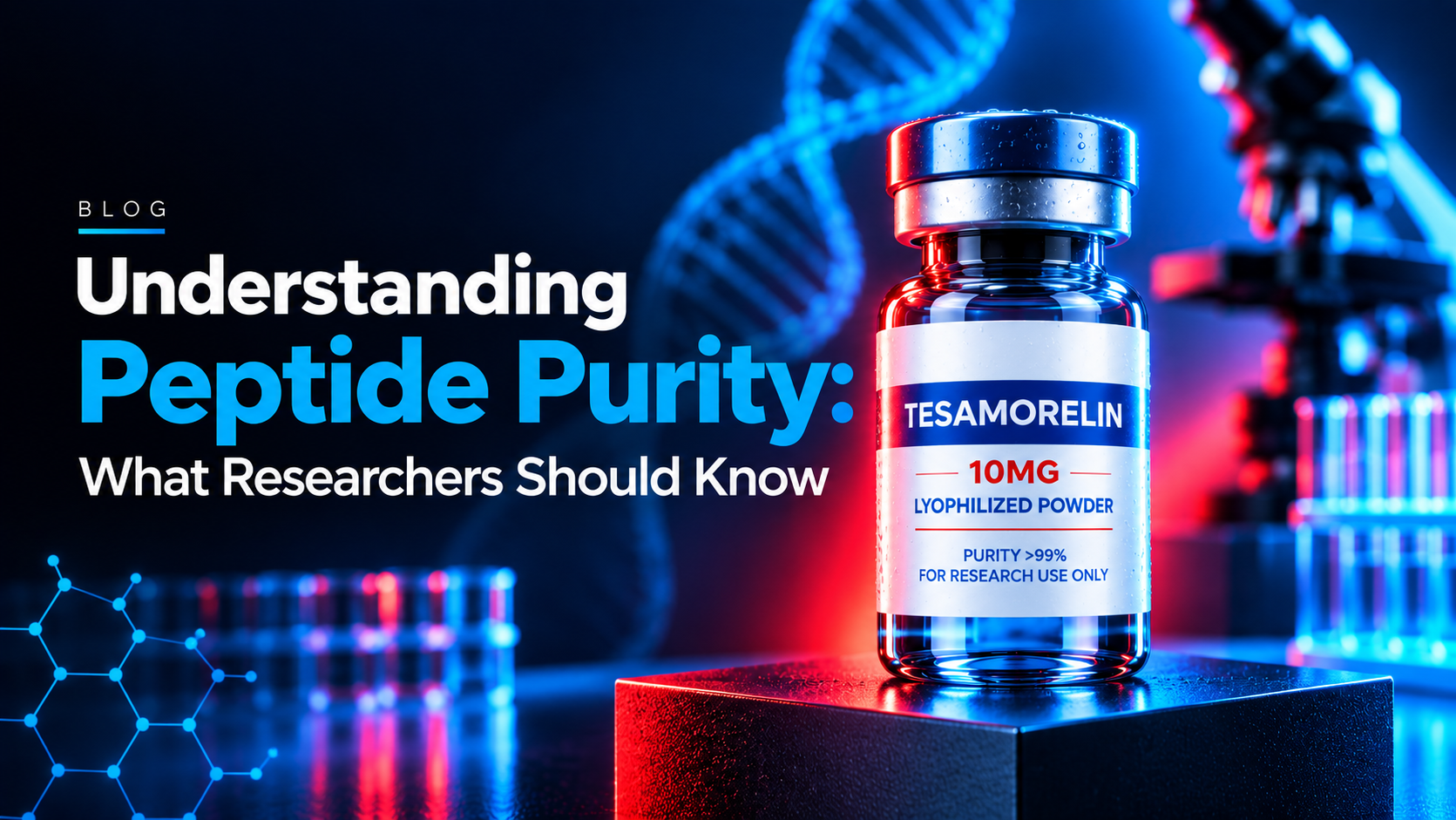
For laboratory researchers, understanding the quality and composition of research materials is an important part of maintaining consistent experimental practices. Peptide purity is one of the key characteristics researchers may review when evaluating a peptide product.
What Is Peptide Purity?
Peptide purity generally describes the proportion of the intended peptide compared with other detectable components in a tested sample.
During synthesis, purification, handling, or storage, peptides may contain other components such as truncated sequences, modified peptides, or degradation products. A reported purity percentage provides useful information about the tested sample, but it should always be considered alongside the analytical method and supporting documentation.
Why Does Peptide Purity Matter?
Researchers often use characterized materials when conducting laboratory experiments. Understanding the purity of a peptide can help researchers:
- Compare materials from different sources
- Review product documentation
- Maintain accurate laboratory records
- Investigate differences between experimental results
- Evaluate consistency between product lots
Purity is only one part of evaluating a research material and does not by itself guarantee a particular experimental outcome.
How Is Peptide Purity Tested?
High-Performance Liquid Chromatography (HPLC) is commonly used to analyze peptides. It separates components within a sample, allowing researchers to examine a chromatographic profile and assess the relative amount of the target component.
Mass spectrometry (MS) can provide information related to molecular mass and can support peptide identity characterization.
Because these methods provide different types of information, researchers may consider multiple analytical results when evaluating a peptide.
What Should Researchers Look for?
When reviewing peptide documentation, researchers may consider:
- Product identity
- Reported purity
- Analytical method
- Lot or batch number
- Test results
- Molecular mass information
- Storage and handling information
A Certificate of Analysis (COA) may provide important lot-specific information and can help researchers understand the analytical results associated with a particular product.
Purity Is Only One Part of the Picture
A high reported purity value does not necessarily answer every question about a research material. Researchers should consider purity together with identity, analytical methodology, testing information, and other available documentation.
Careful evaluation and recordkeeping can support better laboratory practices and help researchers maintain consistency throughout their work.